19th Century
19th Century Miniatures
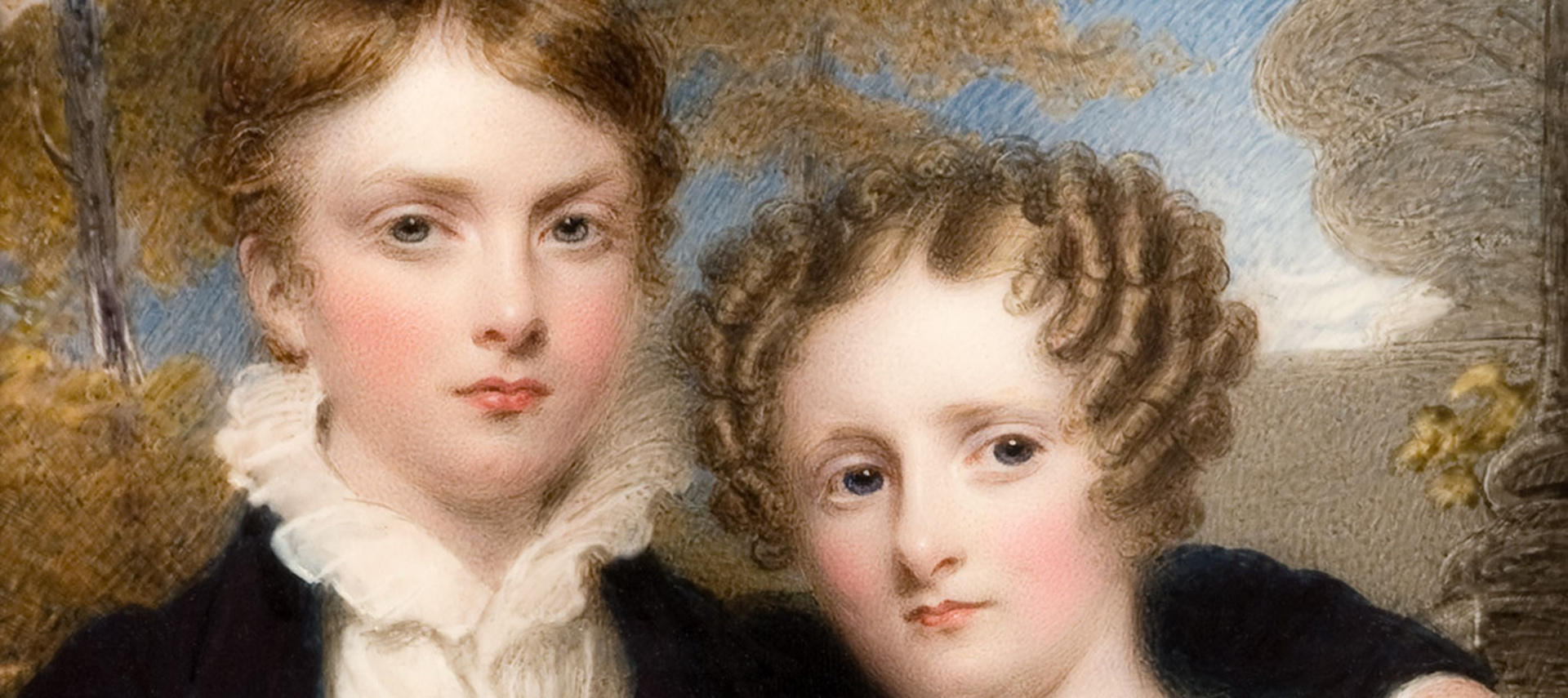
The demand for miniature likenesses was already growing steadily in the second half of the 18th century and in the empire and Biedermeier periods it led throughout Europe to a hitherto unseen proliferation in the number of works. More and more artists specialised in this type of portrait and increasingly refined their production techniques. Today’s observers are fascinated by the direct impact of the sitters. Despite apparent naturalness, however, the representation of rank and position still played an important role, plus the vanity of the ladies and gentlemen had to be taken into account.
Social rank and seduction
What appeals to today’s observers about miniatures of the 19th century is the direct impact of the sitters. The clients wanted miniatures to capture their external appearance. Representation of rank and position played an important role, as it had done in the 18th century, and some sitters therefore had themselves portrayed in front of baroque drapes or chose costly accessories for this purpose. And the vanity of both male and female models had to be taken into account, just as in earlier centuries, which restricted the degree of realism quite considerably in some cases. The creation of an imaginary world, as was often desired in the 18th century, in order to visualise immaterial values, became a rarity in the 19th century. Its place was taken by an earthly, material pictorial language – if often a theatrical one.
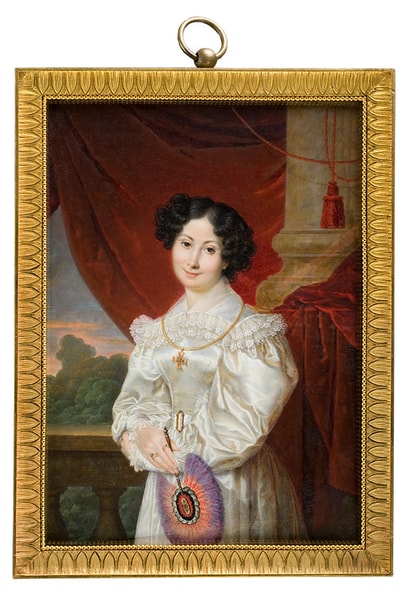
Louis François Aubry: Lady in White Dress with Fan, inv. no.: 10011 read more...
Leading artists and illustrious sitters
Mr and Mrs Tansey never collected systematically, but instead acquired a miniature if it had a subject they liked and was of sufficiently high quality. Their greatest affection was for Continental miniatures, including the French and Austrian schools in particular. There are very few works from England, because the broad method of painting that tried to captivate the eye and the often garish colours in these miniatures are not much to the Tanseys’ taste. However works by Egley, Hargreaves, Newton, Smith and Ward are present, along with a masterpiece by Cruickshank. One remarkable item is Linnell’s miniature showing George Pocock Bart, the inventor of a coach pulled by flying kites (inv. no. 10427, read more...).
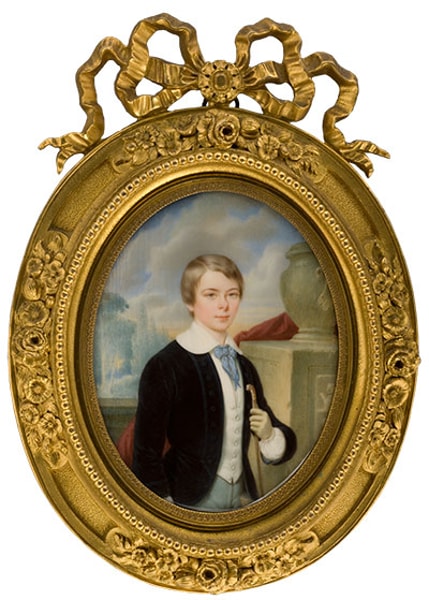
Louis Henri de Fontenay: Hebert de Stacpool, inv. no.: 10264 read more...
French miniatures from the post-Revolutionary period are outstandingly well represented: one finds characteristic pieces by the great masters Augustin and Isabey, along with their gifted students. Among those of Isabey is the excellent Aubry with his virtuoso piece, the lady with a feather fan (inv. no. 10011, read more...). One work of special note by Singry is his magnificent portrait of the singer Fodor-Mainvielle (inv. no 10676). The newly identified self-portrait by Mansion deserves attention as well (inv. no 10506, read more...).
Aubry’s students Meuret and Saint are each represented by several works of top quality, and the crowning glory of French miniature painting is the best student from Meuret’s studio, Cécile Villeneuve. The Austrian miniature portraits are dominated by a selection of first-class likenesses by Daffinger. His masterpieces include a lady in white dress with pink bows (inv. no. 10655, read more...) and the lady resting her elbow on a table (inv. no. 10218, read more...). Daffinger is in the best possible company in Anreiter, whose lady in front of a shore background is a creation of an especially unique and inventive type (inv. no. 10004, read more...).
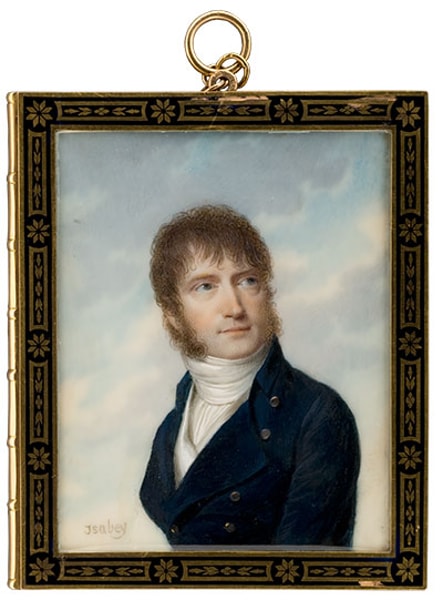
Jean Baptiste Isabel: Mikołaj Oppeln-Bronikowski, inv. no.: 10372 read more...
The major Swiss miniaturists include Comte, Bel, L’Huillier and Dietler. Another highlight is a portrait of a young man, holding a letter in his hand. It was painted by Goulu in 1826 (inv. no. 10285, read more...).
The Tanseys also have a sensitive portrait of a lady wearing a white empire gown, which was painted by Quaglia, an Italian miniaturist who worked principally in Paris and was favoured by Empress Joséphine (inv. no. 10594, read more...).
Among Scandinavian portrait miniatures, those of the 18th century correspond somewhat more to the Tanseys’ taste than do those of the 19th century. Two portraits by Aldenrath, who was born in Lübeck but worked mostly in Denmark, are exquisite examples of the Nordic school. May the works from this often ignored epoch fascinate the readers of the second book just as much as they fascinated the editors!