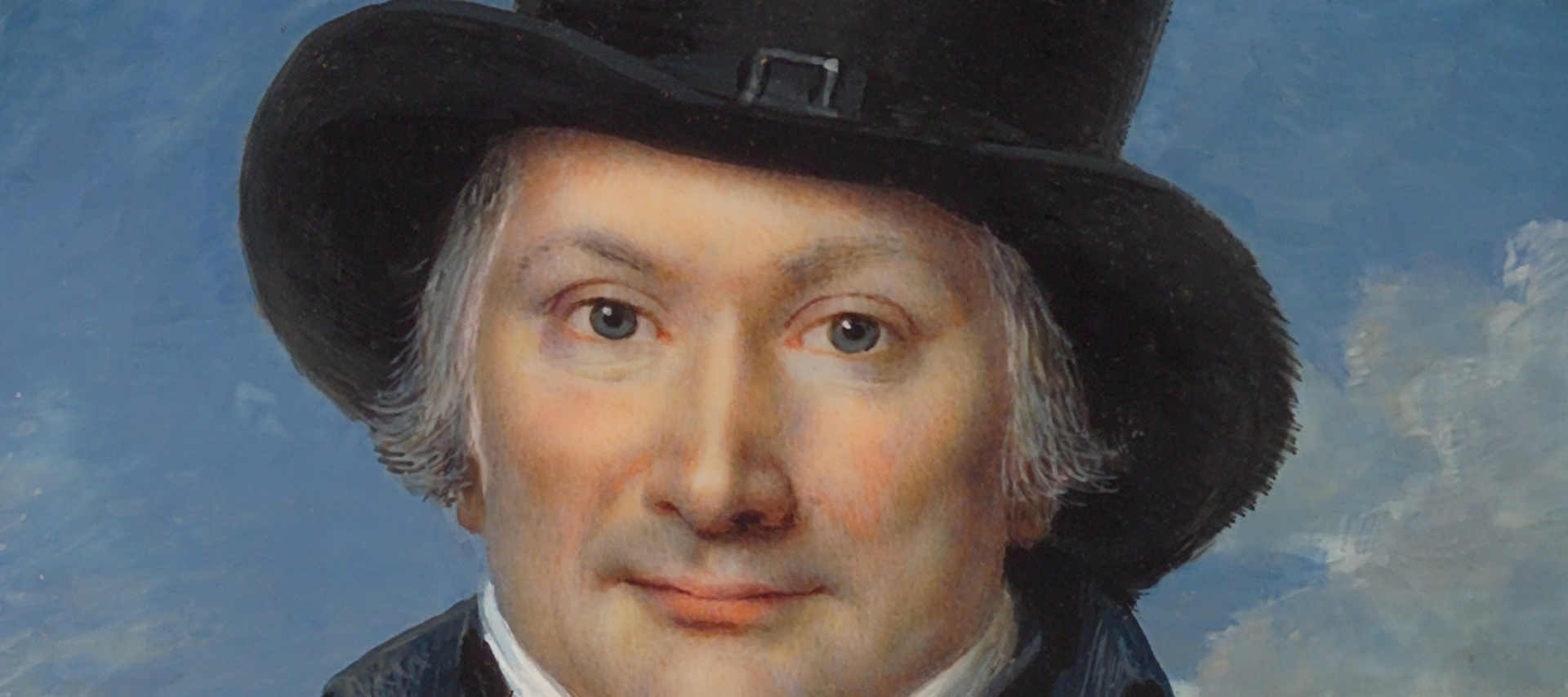
French Revolutionary Period
Miniatures from the Time of the French Revolution 1789-1799
During the decade of the French Revolution, from 1789 to 1799, a noticeably large number of miniatures were created. It was precisely the uncertain circumstances that aroused the desire for small, transportable and personal likenesses, and the miniaturists responded to the keen demand for likenesses by increasing their output and becoming exceptionally inventive. This resulted in portraits that are lively and individual in their portrayals during a turbulent period of transition.
Keepsakes of loved ones in a turbulent time
The years of the French Revolution were a difficult time in miniature painting, but also an especially fruitful one. Jean-Baptiste Isabey, who was only 22 years old at the storming of the Bastille but already the most successful Parisian miniature painter during the Revolution, describes in his memoires an apposite picture of a miniaturist’s situation at the time: “A new way of working opened up – it sprang from the suffering of the time. I sallied forth and offered my services to all these poor souls. For this reason, I christened my new works ‘portraits de consolation’. In one case a mother wished, before emigrating, to bring together in a single locket the faces of her beloved children, and in another a double souvenir was to be exchanged during only one short sitting. How often was I witness to this silent gift of love which was followed by cruel separation! The absence was only going to last for one month, they said. Oh, was it not always farewell for ever! Should I recount my churning emotions, if chance put before my eyes on an execution list the name of one of these admirable faces, whose beauty I was still attempting to capture only on the previous day, and that person’s sensitive devotion and courage of love stamped themselves irrevocably on my memory? ... I was paid little, and did not always receive my fee. An unpaid bill for twenty Louis turned into a catastrophe. On the very evening on which I was to receive this long-awaited sum, I made an appointment with my creditors. Oh! I had not reckoned with the debtor; he had emigrated on the previous day.” (E. de Basily-Callimaki, J.-B. Isabey, sa vie, son temps, 1767–1855, suivi du catalogue de l’œuvre gravé par et d’après Isabey, Paris 1909, p. 17).
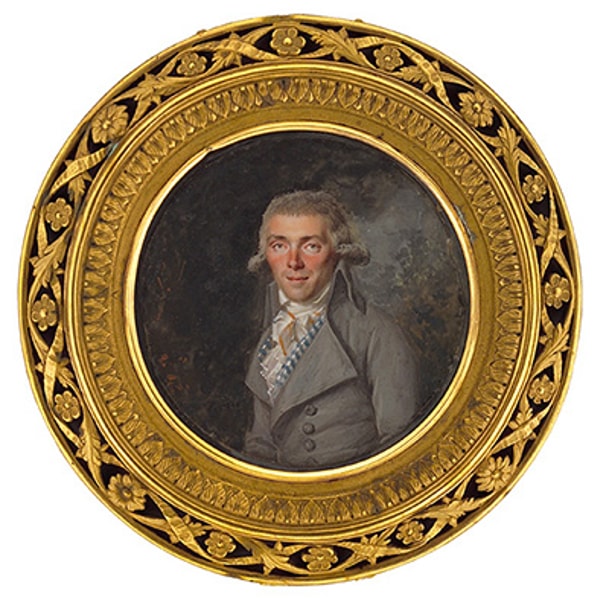
Louis Lié Périn-Salbreux: Gentleman in Grey Coat with Blue and White Striped Waistcoat, inv. no.: 10578 read more...
During the Revolutionary years, great value was attached to the special kind of private portrait that a miniature is. This is easy to understand considering that family members frequently had to accept separation due to emigration, imprisonment or even violent death. “Portraits de consolation”, as Isabey called them, helped alleviate the pain of separation by keeping the absentees in mind. The huge popularity of small-format portraits (miniatures) in comparison with easel portraits can be explained by the fact that they were easier to handle, relatively quick to paint, and cheaper to produce. Moreover, it was possible to create very intimate representations in miniatures, because the small works could easily be hidden from undesired prying eyes. The small format was also easy to stow in one’s luggage, if one should be forced to depart in a hurry.
A gallery of European miniature painting
In the late 18th century France led the whole of Europe in miniature painting; many artists travelled great distances to Paris in order to learn painting techniques there. A large number of items of outstanding quality are present due to Mr and Mrs Tansey’s special interest in French pieces. Augustin and Isabey were the two favourites of the public and of art critics in Paris during the Revolution. They moved away from Hall’s hitherto widespread style with its dainty faces, soft contours and delicate shades of colour, and painted portraits taken from real life showing the nature of the sitter as realistically as possible.
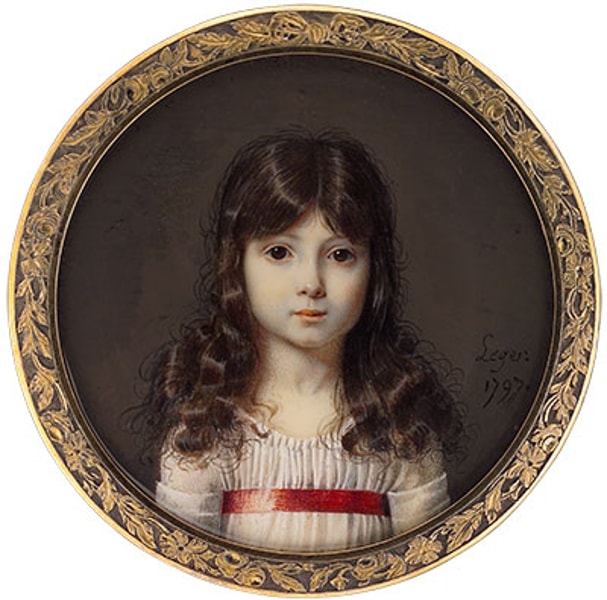
Léger: Girl in White Dress with Red Silk Belt, inv. no.: 10439 read more...
Works of the English school – which was the most important one after the French school – are few in number here, because their direct and often sober style is less to the Tanseys’ taste. Yet the portraits by Chinnery, Cosway, Grimaldi, Hone, Plimer, Miles, Scouler, Shelley and Wood, all of them prominent artists of their time, can give an impression of English miniatures in the 1790s.
German miniaturists in the late 18th century worked over a wide geographical area and therefore demonstrate little common ground in terms of style; furthermore, many artists are barely known. So, the efforts of Mr and Mrs Tansey appear to us to be all the more valuable in acquiring works by German artists. For example, alongside pieces by the known Düsseldorf miniaturists Guerard and Stroely, this volume now also contains some by rarer artists: Taubert, who worked in Berlin, the Hanoverian Ahrbeck and Tielker, whose locations included Celle. There are also rare works by Ritter and Bürckmann, two artists born in Germany but who later worked in Holland.
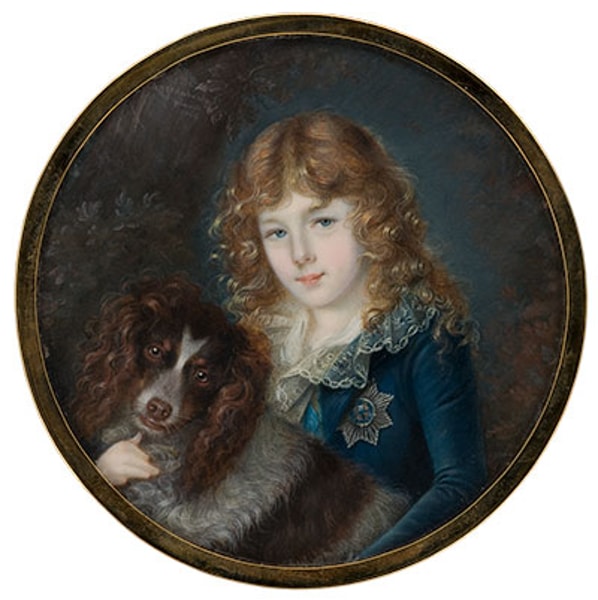
Emmanuel de la Celle, Chevalier de Châteaubourg: Charles of Baden, inv. no.: 10119 read more...
Clock production in Geneva led to a high standard of enamel painting there. Parallel to this, miniature painting on ivory also reached a high standard in the second half of the 18th century. This selection contains the works by Arlaud-Jurine, Bouvier, Fabre and Sené, representing the western Swiss tradition of quality miniature painting.
Among the Italian artists Domenico Bossi stands out, a widely travelled miniaturist from Trieste. The likenesses of Frederick Francis I (inv. no. 10073, read more...) and his wife Louise are of particular historic interest – and informative about Bossi’s career (inv. no.: 10072, read more...).
When viewing all the portraits of people who lived during the turbulent years of the French Revolution, one may feel something of the emotions that were frequently the motivation for having a miniature painted; and may develop respect for those who often worked under difficult circumstances applying their talent, but also a great deal of hard work and stamina, often at cost to their health, to create this fascinating “world in miniature”.
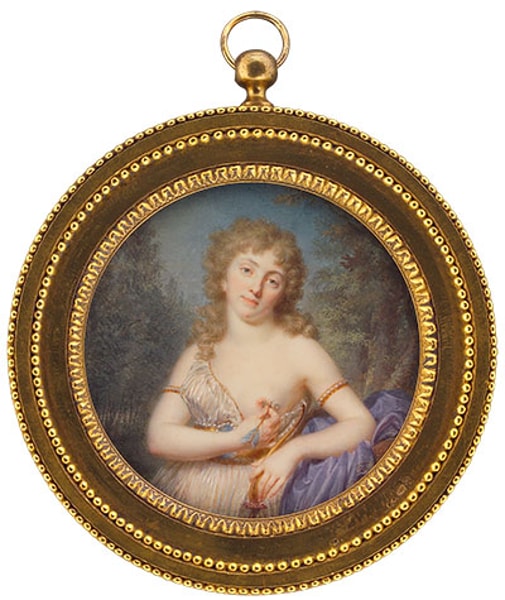
Jean-Baptiste-Jacques-Augustin: Lady with an Arrow, inv. no.: 10015 read more...